The infrastructure growth and building sector in India is experiencing a paradigm shift. Due to structural weight reductions, speed of construction, and strict environmental regulations on topsoil excavation, builders are rapidly replacing traditional red clay bricks with Autoclaved Aerated Concrete (AAC) blocks. For manufacturers and real estate developers, this surging market demand translates to an exceptional B2B investment opportunity. However, establishing a sustainable, profitable AAC block manufacturing business depends heavily on selecting the right machinery partner.
A plant's continuous output, product dimensional accuracy, rejection rates, and thermal insulation capabilities are directly determined by the engineering design of its machines. In this technical guide, we will analyze the key parameters involved in starting a block factory, detail the essential machinery systems, compare capital costs, and explain why domestic turnkey engineering partners are the most cost-effective choice for industrial investors in the Indian market.
Understanding the Shift: Why AAC is Replacing Clay Bricks
Traditional brick kilns require firing fertile agricultural soil at high temperatures, emitting large volumes of carbon dioxide and causing severe land degradation. Recognizing this, the National Green Tribunal (NGT) and various state boards have implemented strict operational bans and proximity limits on clay brick kilns. Concurrently, government fly ash utilization policies make industrial by-products from thermal power plants cheap and accessible. For industrial plant owners, this creates a highly profitable manufacturing environment where raw material fly ash is available at minimal costs, while clay brick suppliers are facing supply chain disruption.
From a building perspective, AAC blocks provide major structural advantages. Weighing nearly one-third of a standard clay brick of the same volume, they reduce the dead load of structural concrete frames in high-rise buildings by up to fifteen percent, leading to substantial structural steel savings. Their larger dimensions allow masonry work to be completed three times faster, reducing structural labor and mortar adhesive consumption. Consequently, builders are actively seeking certified local AAC block suppliers, making the manufacturing business highly sustainable.
Core Equipment Systems in a Modern AAC Manufacturing Factory
An automated autoclaved aerated concrete block plant is a complex assembly of heavy civil, mechanical, and electrical control systems working in a continuous cycle. Let us break down the critical equipment components required for a standard factory setup:
1. Raw Material Storage and Preparation
Raw materials like fly ash (or sand), lime powder, gypsum, and OPC cement must be prepared to exact particle size distributions. The factory layout starts with heavy-duty storage silos equipped with pneumatic loaders and fluidizing systems to prevent cement and fly ash compaction. A robust wet ball mill is used to grind sand or fly ash into a high-density aqueous slurry (usually targeting a specific gravity between 1.60 and 1.65). This slurry is pumped into agitated slurry storage tanks where it is kept in constant motion to prevent solids from settling.
2. Precision Automatic Batching and Mixing System
The chemical reaction inside the slurry mixture relies on exact ratios of cement, lime, gypsum, and aluminum powder expansion agent. Modern factories utilize automated weighing hoppers for both liquid slurry and dry powders, suspended from electronic load cells. The batching control system, managed from a central PLC control panel, doses the ingredients into a high-speed slurry mixer. The temperature of the water-slurry mixture is critical and must be maintained between 40°C and 45°C to initiate the primary cement hydration and aluminum expansion reactions when poured into curing moulds.
3. Curing Moulds and Slurry Expansion
Once mixed, the active slurry is poured into precision-engineered mould boxes, which are transported on track lines to pre-curing chambers. In these chambers, the temperature and humidity are controlled to allow the aluminium powder to react with the calcium hydroxide in the cement, releasing hydrogen gas. This gas creates millions of microscopic spherical air cells inside the mixture, causing the cake to expand to its full height (like bread rising). Within two to three hours, the mixture achieves a green strength equivalent to hard cheese, making it ready for cutting.
4. The Cutting Line: Heart of the Plant
The cutting line determines the dimensional accuracy and surface finish of the blocks. A specialized demoulding clamp lifts the mould box, leaving the soft green cake on the mould base. The cake is then fed into the horizontal and vertical cutting machines. High-tensile steel cutting wires oscillate at high frequencies to slice the cake to exact block dimensions (such as 600mm x 200mm x 100mm/150mm/200mm) with tolerances of within +/- 1.5mm. Precision cutting is crucial; uneven cuts result in poor masonry alignment, high rejection rates, and lost profits.
5. Autoclave Steam Curing
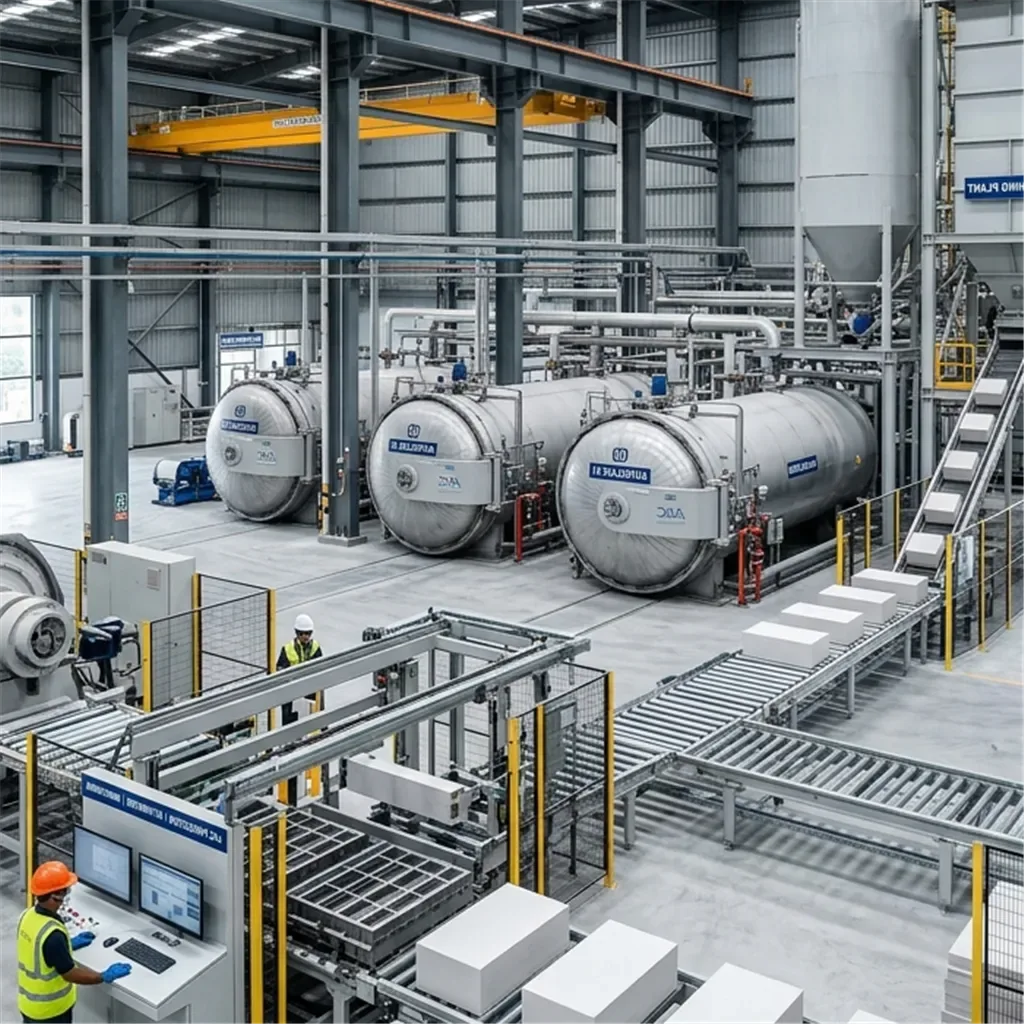
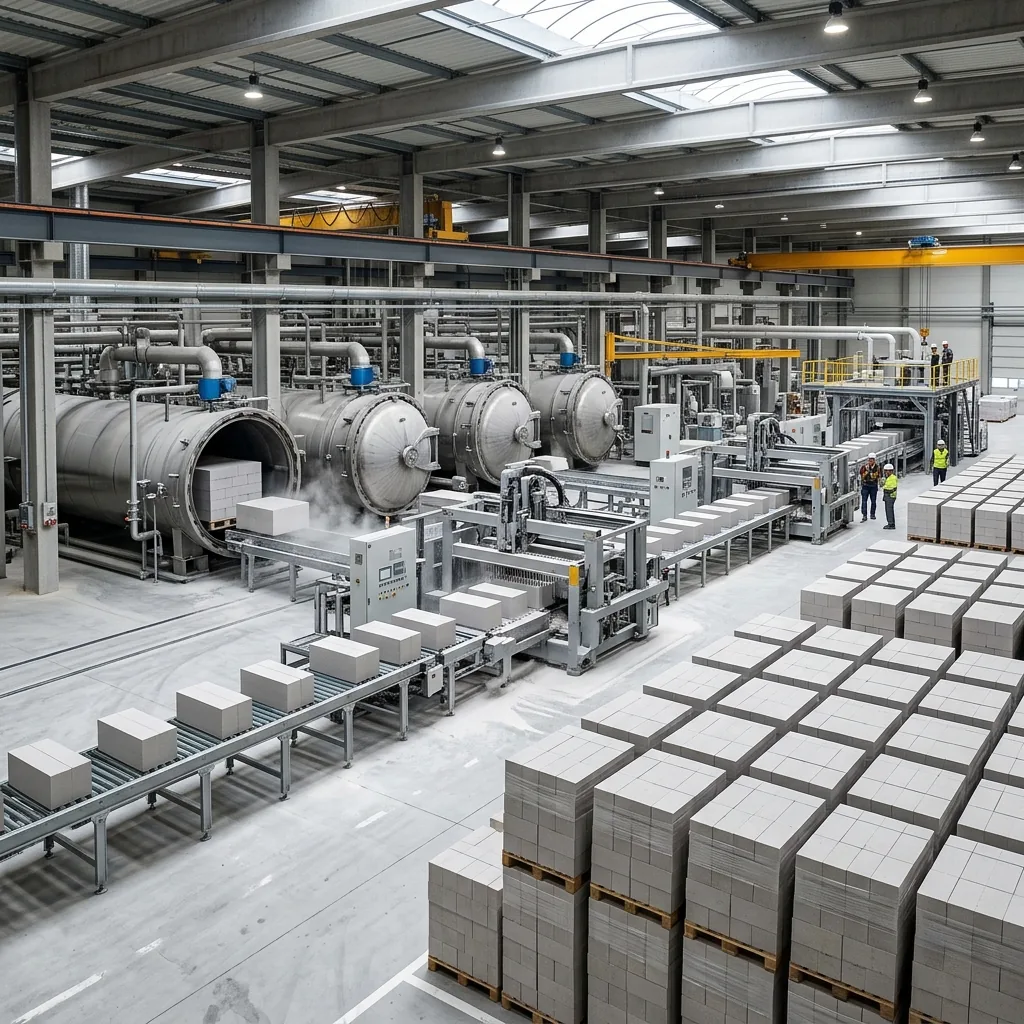
The final structural strength of AAC blocks is achieved through hydrothermal synthesis. The cut blocks, still on curing cars, are wheeled into heavy-duty autoclave chambers. These thick steel pressure vessels are sealed, and high-pressure steam is injected. The curing process is carried out at a pressure of 12 bar (1.2 MPa) and a temperature of 185°C to 190°C for approximately 10 to 12 hours. Under these conditions, the silica in the fly ash reacts with the calcium in the lime to form Tobermorite crystals, providing the blocks with their high compressive strength and low drying shrinkage properties.
| Processing Stage | Key Equipment Involved | Operational Parameter / Target | Importance to Quality & Cost |
|---|---|---|---|
| Milling & Storage | Wet Ball Mill, Agitated Tanks, Silos | Slurry density: 1.60 - 1.65 kg/L | Pre-conditions fly ash/sand particle size for correct hydration chemistry. |
| Batch Mixer | Load Cell Hoppers, High Speed Mixer | Temperature: 40°C - 45°C | Ensures uniform distribution of aluminium powder for consistent density. |
| Cutting Line | Horizontal & Vertical Cutters, Wire Oscillation | Dimensional tolerance: +/- 1.5mm | Prevents block wastage and allows thin-bed mortar jointing on site. |
| Autoclaving | Steam Boiler, Autoclaves, Condensation Systems | Pressure: 12 Bar, Temp: 185°C | Forms Tobermorite crystals to establish structural load-bearing strength. |
Turnkey Plant CAPEX: Setup Capacity & Land Requirements
For B2B investors running feasibility studies, mapping out initial capital expenditures (CAPEX) and operating budgets (OPEX) is essential. The total investment cost of starting a factory depends heavily on the plant capacity. Standard configurations generally start at 18 Cubic Meters (CuM) per day and scale up to 72+ CuM per day. A typical entry-level 18 CuM turnkey plant setup starts from 95 Lakhs (95 lac) and represents a highly practical model for regional markets:
- 18 CuM Daily Capacity Plant: Ideal for regional growth pockets. Features a semi-automatic cutting system, single autoclave, and requires approximately 1.5 acres of land and a 100 HP electrical connection. Entry cost starts from 95 Lakhs.
- 36 CuM Daily Capacity Plant: A medium-scale setup utilizing automatic raw material batching, dual autoclaves, and an automated vertical cutting line. Requires 2 acres of land and a 150 HP power supply.
- 54 CuM Daily Capacity Plant: Designed for competitive construction markets near major cities. Features automated slurry and powder batching with integrated PLC panel systems and a high-speed wire cutting line.
- 72 CuM Daily Capacity Plant: A heavy industrial setup running 24/7. Equipped with automated mould transit systems, multiple autoclaves, and automatic packaging lines, requiring 3+ acres and a 200+ HP power grid.
For developers and new business owners, starting with a 18 CuM or 36 CuM fly ash based AAC block plant setup is a low-risk strategy. It permits gradual capital allocation, lets the team establish local supply chains, and can be scaled on demand by adding extra autoclave tubes and curing moulds without modifying the primary slurry mixing tower or ball mill layouts.
Why Choose an Indian Machinery Manufacturer Over Importing
While imported machinery might appear attractive, experienced industrial plant owners in India strongly advise partnering with an established domestic manufacturer like Balaji Construction Machines and Spares for several reasons:
"Having a local manufacturing partner in India ensures that engineering teams can reach your plant within twenty-four hours to handle calibrations, electrical troubleshooting, or raw material variation adjustments."
- Raw Material Adaptability: Fly ash chemical composition, moisture levels, and carbon content vary drastically from one power plant to another in India. Domestic manufacturers engineer their high-speed mixers and batching software specifically to handle these regional fly ash variations.
- Power Grid Optimization: Electrical grids in regional industrial zones often experience voltage fluctuations. Indian manufacturers design their PLC control panels and motor drives to withstand these conditions, avoiding expensive board burnouts.
- Rapid Spare Parts Supply: A single day of factory downtime due to a broken cutting line or autoclave gasket can cost lakhs in lost production. Working with an Indian supplier based in Maharashtra ensures instant courier delivery of replacement parts.
- Direct Inspection & Trust: Investors can easily travel to manufacturing centers in Satara to witness machinery fabrication, inspect steel quality, and check the calibration of cutting tables first-hand before dispatch.
Operational Cost Reduction: Steam Condensation & Product Diversification
Maintaining strong operating margins in a B2B business requires keeping a close check on monthly utility costs. Boiler fuel (coal, briquettes, or gas) represents a major recurring expenditure. Installing an energy recovery system that recycles hot condensation water and waste steam from one autoclave to pre-heat the next autoclave cuts fuel usage by up to thirty percent. Utilizing high-efficiency steam boilers with low power consumption further maximizes gross margins.
Additionally, forward-thinking factory owners are expanding beyond standard block dimensions. Modern automated cutting systems can be easily reprogrammed to manufacture structural wall panels and lintels. AAC wall panels, reinforced with steel mesh, are gaining immense traction in high-rise precast construction due to their rapid dry-wall installation speed. By catering to this premium precast market, manufacturers can charge higher rates and significantly boost their overall business profitability.
Conclusion: Partnering for Industrial Success
Starting an autoclaved aerated concrete block factory in India is a highly profitable, sustainable business model. The key to industrial success lies in combining energy-efficient machinery, a cost-effective fly ash recipe, and a reliable turnkey machinery manufacturer. By avoiding the pitfalls of low-quality imported equipment and working with a dedicated domestic partner, you can ensure high output, low rejection rates, and a rapid return on investment.
Balaji Construction Machines and Spares provides comprehensive turnkey setup services, custom factory layout designs, machinery installation, and operator training to help you start your factory successfully. Contact our engineering team in Satara to receive a detailed project feasibility report for your location.
B2B Turnkey Setup Solutions Across India & Maharashtra
Based in the industrial zone of Satara, Maharashtra, Balaji Construction Machines and Spares is a premier engineering company fabricating automated AAC block plants and precast concrete systems. We offer end-to-end commissioning, custom layout drawings, and on-site training for industrial buyers across major markets, including Mumbai, Pune, Nagpur, Nashik, and Aurangabad.
Our project reach extends to fast-growing construction sectors across India, serving clients in Gujarat, Madhya Pradesh, Karnataka, Andhra Pradesh, Telangana, and Tamil Nadu. Whether you are using our online setup cost calculator, checking detailed machinery specifications, or seeking a technical site layout proposal, we are here to support your venture. Contact our sales team to request a quote or arrange a factory visit.